.jpg)
.jpg)


How to Source Bulk Tata Car Spare Parts from India: A Complete Guide for Global Importers

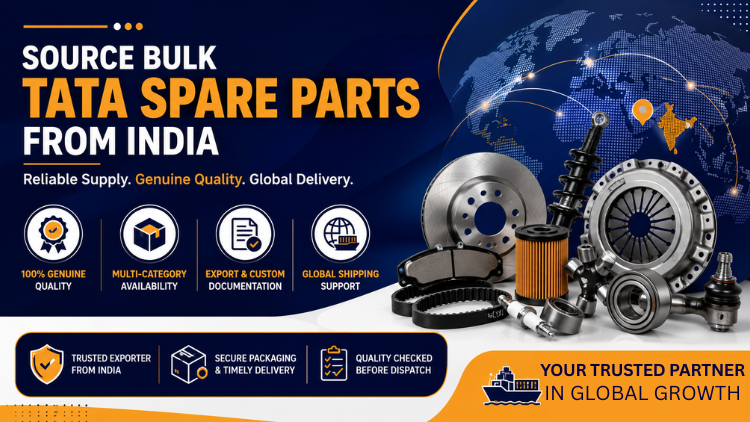
For international automotive distributors and regional wholesale buyers, establishing a stable supply chain for genuine Tata passenger vehicle components is critical to scaling operations. Sourcing components directly from India offers access to comprehensive catalogs, but navigating international logistics, verification, and bulk shipping requires a structured procurement process.
Whether you are importing for a local retail network or managing a regional distribution hub, this guide breaks down the operational steps, documentation requirements, and quality checks necessary for standard bulk sourcing.
Why Global Buyers Source Tata Spare Parts from India
Navigating the international automotive aftermarket requires a balance of component diversity and manufacturing reliability. Sourcing passenger vehicle items from the Indian subcontinent allows international procurement houses to consolidate their purchasing operations.
The primary structural advantages include:
Established OEM Ecosystem: Access to components manufactured under strict industrial frameworks, ensuring standard dimensional accuracy and material integrity.
Export-Ready Supply Networks: Vendors accustomed to global trade protocols, standardized border documentation, and maritime packaging demands.
Comprehensive Inventory Alignment: The capability to manage multiple product lines from mechanical groups to body and exterior components under one supply arrangement, minimizing the need to coordinate with fragmented regional merchants.
Tata Car Models and Spare Parts Availability
An efficient procurement strategy relies on a supplier's capability to cover both legacy platforms and modern vehicle configurations. When organizing your container orders, inventory compilation typically spans across distinct automotive generations.
Overseas distribution networks generally focus their bulk requisitions around these specific vehicle lines:
Passenger Cars & Hatchbacks: High-turnover components for models such as the Nano, Tiago, Tigor, Bolt, Zest, Indica, Indica Vista, and Indigo.
Utility Lines & SUVs: Heavy-duty structural elements and engine items for the Nexon, Safari, and Sumo.
When optimizing supply chains, reviewing how global buyers manage procurement allows international distributors to eliminate local middleman markups.
High-Demand Component Categories for Bulk Procurement
To maximize maritime container space and maintain balanced warehouse turnover, wholesale orders are systematically divided into functional mechanical and cosmetic groups.
Engine & Transmission Parts
Importers buy heavy-wear internal components and mechanical assemblies for routine engine overhauls and transmission servicing.
Factory pistons and cylinder heads
Complex transmission seals and gaskets
High-pressure engine oil pumps
Complete clutch assemblies (friction plates, pressure assemblies, and release bearings)
Steering & Suspension Parts
Distributors order certified undercar chassis items due to high localized mechanical wear and regular replacement cycles on rough roads.
Certified suspension arms and linkages
Heavy-duty shock absorbers and struts
Steering tie rod ends and ball joints
Stabilizer bars and bushes
Brake System Components
Friction materials and hydraulic components dominate stock orders to support continuous automotive garage maintenance networks.
Original front and rear brake pads
Ventilated brake discs and rotors
Hydraulic brake calipers
Fluid master cylinders
Body & Exterior Components
Structural metal panels and plastic collision items occupy the highest container volume to support regional accident restoration shops.
Front and rear protective bumpers
Radiator grilles and structural fenders
Engine bonnets and side panels
Side-view mirrors and complete lighting assemblies (headlamps and taillamps)
Tracking the most exported parts ensures overseas wholesalers maintain high-turnover stocks that match regional vehicle repair frequencies.
How to Evaluate a Tata Spare Parts Exporter
Selecting a cross-border supply partner requires careful validation of operational capabilities rather than reliance on generic commercial promises. Importers should vet potential export houses against specific criteria:
Catalog Depth: The vendor's capacity to supply diverse model groups simultaneously, preventing the administrative burden of managing split multi-vendor contracts.
Logistics Competence: Proven familiarity with international maritime lanes, port routing optimizations, and changing customs mandates.
Industrial Packaging Protocols: Adherence to rigid preservation techniques that guard delicate components against moisture and physical impacts during long voyages.
Consolidation Facilities: Possession of dedicated warehousing where distinct part categories can be collected, scanned, and packed systematically before container loading.
Operational Matrix: Consolidated Export Partner vs. Multi-Vendor Sourcing
The operational structure chosen directly impacts freight expenditures and warehouse processing times at the destination port.
Sourcing Parameter | Consolidated Export Partner | Direct Multi-Vendor Sourcing |
Lead Time Efficiency | Optimized; parts are centralized at a single facility before transit. | Extended; individual manufacturing delays hold up the entire shipment. |
Documentation Handling | Single unified customs invoice and one combined packing list. | Disjointed; multiple separate invoices increase local port entry fees. |
Packaging Standards | Uniform, heavy-duty seaworthy palletization across all items. | Inconsistent; varied protective measures raise transit damage risks. |
Freight Optimization | Maximum utilization of container volume via balanced loading. | Costly; higher rates due to fragmented, partial shipments. |
Multi-Category Container Consolidation & Export Packaging
B2B procurement workflows avoid fixed volume restrictions by matching shipping modes with precise order values, product mixes, and regional destination profiles.
Industrial Consolidation (FCL & LCL)
Wholesale entities can adjust their logistics footprint based on current market demands. Buyers may consolidate mixed spare parts inventories through Full Container Load (FCL) or Less than Container Load (LCL) shipments depending on order volume and destination requirements. This flexibility protects inventory planning and freight flexibility while maintaining a steady inventory pipeline.
Export Cargo Layering Protocol
Position Matrix | Core Component Allocation | Industrial Preservation Protocol |
03 / Top Elevation | Delicate Electricals, ECUs, Sensors, & Filters | Sealed inside multi-wall corrugated boxes packed with moisture-absorbent silica packets. |
02 / Mid Elevation | Body Panels, Grilles, Fenders, & Headlamp Units | Individually shock-insulated with high-density poly bubble wrap to isolate vibration. |
01 / Ground Elevation | Engine Blocks, Brake Rotors, & Control Arms | Fixed onto chemically treated ISPM-15 wooden pallets to bear structural weight. |
Pre-Shipment Quality Control & Part Verification
Cross-border returns are economically impractical, making pre-dispatch verification essential to protect capital investments. Reliable export operations execute specific quality control steps at the consolidation warehouse:
Digital Code Verification: Every component code undergoes physical scanning against the master proforma sheet to eliminate part number mismatches.
Visual Thread & Surface Inspection: Checking machining tolerances on steering linkages and ensuring bare metal surfaces receive anti-corrosive oil coatings.
Batch Count Validation: Verifying inner seals on multi-pack items to ensure shipments match the declared packing list exactly, minimizing wrong-part dispatch risk and transit-related damage risks.
Export Documentation & Global Shipping Compliance
Customs clearance hitches can result in unexpected port storage costs or demurrage charges. Partnering with an established spare parts exporter guarantees that international shipping documentation complies fully with your local port authority requirements.
Every bulk shipment must travel with a complete, legally compliant document packet:
Bill of Lading (B/L): The primary maritime contract governing ocean transit between the dispatch and entry ports.
Commercial Invoice & Itemized Packing List: Specifying exact net weights, exterior dimensions, individual values, and precise carton locations.
Certificate of Origin: Vital for verifying manufacturing source points and accessing preferential tariff structures under international trade pacts.
Harmonized System (HS) Classifications: Ensuring precise compliance with Chapter 87 customs regulations (e.g., HS Code 8708.30 for brake elements and HS Code 8708.80 for suspension networks) to rule out misclassification penalties.
Conclusion
Establishing a dependable sourcing pipeline from India requires systematic verification, proper container management, and meticulous document handling. By aligning with a partner capable of executing strict pre-shipment inspections and multi-category consolidation, global distributors can protect their procurement investments and ensure a steady supply for their regional trade networks.
Commercial Inquiry: Share your required Tata spare parts list or target vehicle models to evaluate product availability, export packaging options, and shipping schedules.
Frequently Asked Questions (FAQ)
How can I choose a reliable Tata spare parts exporter in India?
Evaluate candidates based on their actual catalog width across multiple vehicle platforms, verifiable experience with international maritime customs, and the use of standardized, palletized export packaging.
Which Tata vehicle models are commonly sourced by international distributors?
Distributors frequently source components for high-volume legacy and current platforms, including hatchbacks like the Indica, Tiago, and Nano, alongside larger utility lines such as the Safari, Nexon, and Sumo.
Can multiple Tata spare part categories be shipped in one container?
Yes. Multi-category consolidation is a standard logistics practice. Heavy mechanical assemblies form the container base, while body panels occupy the center, and delicate electrical components are packed safely at the top.
What documents are required for importing Tata spare parts?
A standard export packet includes the Bill of Lading, Commercial Invoice, Packing List, Certificate of Origin, and accurate Chapter 87 HS code classifications for custom clearance.
How are spare parts verified before international shipment?
Items undergo digital part-number scanning against the original order sheet, paired with manual visual checks for thread integrity and rust-prevention coatings before container sealing.
What factors affect lead times for bulk Tata spare parts orders?
Lead times are primarily influenced by the diversity of the order list, the time required to consolidate components from different product groups, and current ocean freight carrier schedules.


Comments